Burgundy

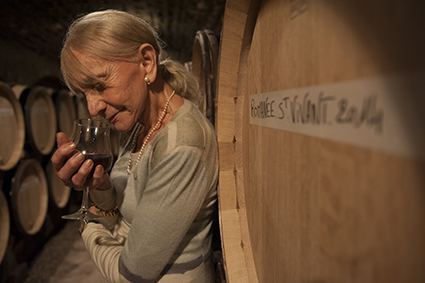
Lalou Bize-Leroy’s legendary domaines, biodynamically farmed, creating rare Burgundies of unmatched purity, intensity, and finesse.
Domaine Leroy and Domaine d’Auvenay together occupy a singular position within the Burgundian wine landscape. Both driven by Lalou Bize-Leroy, they embody two complementary scales of the same vision: understanding, cultivating, and expressing terroir with absolute precision.
Located between Vosne-Romanée, at the heart of the Côte de Nuits, and Saint-Romain, in the northern part of the Côte de Beaune, the two estates are part of a shared continuity while developing distinct approaches. Domaine Leroy, with approximately 22 hectares, offers a structured reading of the great grands crus of the Côte d’Or. Domaine d’Auvenay, with around 4 hectares spread across micro-parcels, pushes this approach toward a more radical, parcel-by-parcel interpretation, where each vine is observed individually.
While Lalou Bize-Leroy remains closely associated with Domaine de la Romanée-Conti, it is through these two estates that her vision finds its most complete expression today.
Domaine Leroy: An estate rooted in the great climats
Domaine Leroy holds parcels across several of Burgundy’s most emblematic grands crus. In Vosne-Romanée, the vineyards of Richebourg and Romanée-Saint-Vivant lie on shallow brown limestone soils, rich in stones and gravel, encouraging deep root systems and natural grape concentration. In Chambolle-Musigny, the Musigny Grand Cru parcel is planted on finer limestone soils, bringing tension and aromatic finesse. In Gevrey-Chambertin, Chambertin Grand Cru expresses a more structured and vertical profile, supported by deep marl-limestone soils. In the Côte de Beaune, Corton and Corton-Charlemagne feature more compact marl-limestone soils, particularly well suited to Chardonnay in the case of Corton-Charlemagne, producing white wines of notable density and remarkable aging potential. The average vine age is high, often exceeding 40 years, with some parcels over 60 years old. This vine maturity plays a direct role in the natural concentration of the berries and the aromatic complexity of the wines.
Domaine d'Auveney: A fragmented and meticulous parcel selection
The defining feature of Domaine d’Auvenay is the dispersion and small size of its vineyards. This fragmentation requires separate vinification for each parcel. In Saint-Romain, high-altitude limestone soils contribute tension and verticality to the white wines. The ventilated slopes allow slow maturation while preserving natural acidity. In Meursault and Puligny-Montrachet, deeper marl-limestone soils give rise to chardonnays that combine density with precision and mineral drive. In Auxey-Duresses and Volnay, the pinot noirs express themselves on clay-limestone soils, resulting in more lifted and finely structured wines. In the Côte de Nuits, the parcel of Mazis-Chambertin Grand Cru sits on rich limestone marls, producing wines of depth and structural intensity. The average vine age is often above forty years, with some parcels originating from older massal selections, enhancing aromatic complexity and concentration.
Both Domaine Leroy and Domaine d’Auvenay have been farmed biodynamically since the late 1980s. This approach is grounded in agronomic conviction: preserving and enhancing soil vitality to allow the vine to fully express its environment. Soils are regularly ploughed. No herbicides are used. Treatments are kept to a strict minimum, relying on biodynamic preparations applied according to the lunar calendar. Yields are extremely low. They generally range between 15 and 25 hectoliters per hectare at Domaine Leroy, and are often below 20 hectoliters per hectare at Domaine d’Auvenay. These low yields result from a combination of factors: vine age, naturally low crop loads, severe selection, and targeted vineyard work. Harvesting is entirely manual, with rigorous sorting to retain only perfectly ripe and healthy fruit.
In both estates, winemaking follows a common principle: minimal intervention, combined with absolute control. For red wines, whole clusters may be partially used depending on the vintage and stem maturity. Fermentations rely exclusively on indigenous yeasts. Macerations are long but carefully managed, allowing for gradual extraction without harshness. At Domaine Leroy, this approach supports structure and depth, in line with the scale of its terroirs. At Domaine d’Auvenay, vinification is even more finely tuned to each parcel, with a constant focus on precision and finesse in extraction. For white wines, fermentations take place in French oak barrels. Lees work is conducted with precision to build texture and depth while preserving natural tension. Batonnage is not systematic and depends on the vintage and the desired profile. No systematic fining is applied. Filtration is minimal, if used at all.
Wines from both estates are aged in French oak barrels for a period generally ranging from 18 to 24 months. The proportion of new oak varies depending on appellation and vintage, but always remains integrated within the overall balance of the wine. The purpose of aging is not to mark the wine, but to support its structure, stabilize its texture, and allow for gradual integration of tannins and balance. Bottling is carried out with minimal intervention in order to preserve the wine’s integrity and aging potential.
Wines from Domaine Leroy and Domaine d’Auvenay are defined by their natural concentration, consistently supported by strong internal tension. At Domaine Leroy, wines display breadth, density, and significant aging capacity. In their youth, they may appear reserved, before gradually revealing complex aromas of ripe fruit, spice, florals, and tertiary notes over time. At Domaine d’Auvenay, the wines reflect a more precise and refined reading of terroir. Reds show a delicate yet deep structure, while whites combine density, mineral energy, and length. Aging potential is high across both estates, often exceeding twenty to thirty years for grands crus in balanced vintages.
Within a well-structured cellar, these wines hold a central position: Domaine Leroy for its ability to express the depth and longevity of great terroirs, Domaine d’Auvenay for the rarity and extreme precision of its parcel-based expressions.
Where are Domaine Leroy and Domaine d’Auvenay located?
Domaine Leroy is based in Vosne-Romanée, in Burgundy, at the heart of the Côte de Nuits. Domaine d’Auvenay is located in Saint-Romain, in Burgundy, with vineyard holdings across both the Côte de Beaune and the Côte de Nuits.
Are the estates farmed biodynamically?
Yes. Both estates are fully farmed according to biodynamic principles. Domaine Leroy has practiced biodynamics since the late 1980s, while Domaine d’Auvenay follows a rigorous, fully integrated biodynamic approach with regular soil work.
What wines do they produce?
Domaine Leroy produces some of Burgundy’s most iconic Grands Crus, including Richebourg, Romanée-Saint-Vivant, Musigny, Chambertin, Clos de Vougeot, Corton and Corton-Charlemagne. Domaine d’Auvenay produces a wide range of appellations across both whites and reds, including Saint-Romain, Auxey-Duresses, Meursault, Puligny-Montrachet, Volnay, Vosne-Romanée, and Mazis-Chambertin Grand Cru.
How long are the wines aged?
Wines from both estates are typically aged between 18 and 24 months in French oak barrels.
What is the ageing potential of the wines?
The wines from both Domaine Leroy and Domaine d’Auvenay have remarkable ageing potential. The Grands Crus and top cuvées can evolve over several decades, depending on the vintage, for both red and white wines.